What are peptides?
Peptides are short amino acid chains (similar to small proteins). Some peptides are
prescription medicines that can have a wide variety of effects on the human body,
including collagen production, stimulation of human growth hormone, weight loss and
reduced inflammation. However, many peptides are bought online as “research
chemicals” and are not regulated or approved for human use. Using these unregulated
peptides is a risk and long-term safety is unknown.
Some essential information to help keep you safer
When you’re preparing your peptides to inject subcutaneously (into fat):
- Keep peptides in the fridge in a dark container (they’re sensitive to light).
- Wash and dry your hands thoroughly. Arrange your sterile equipment on a clean
surface. - Clean your injection site with soap and water or an alcohol swab (swipe in one
direction only – don’t rub). - For subcutaneous injections, stomach and thighs are best, keep 5cm away from your
tummy button. Skin should be pinched and the needle inserted at a 90-degree angle
(straight up). Inject the substance slowly. - Best practice - attach a new needle to a suitable syringe to draw up the substance
and then attach another new needle to inject. Using the same needle twice can blunt
the needle which can cause tissue damage. - Dispose of your needles in an approved returns container. Returns containers can be
disposed of at your local needle exchange or pharmacy – see
https://www.nznep.org.nz/outlets for your closest provider. - Don’t share injecting equipment and use a new needle and syringe for each injection.
- Understand that you can’t be 100% sure of purity & effectiveness, so start with small
amounts, and gradually adjust your doses up (titrate) over time. - Alternate/rotate injection sites to reduce tissue damage.
- Avoid injecting into damaged or infected skin.
- Seek help early if something feels wrong.
- Needle Exchanges and pharmacies that offer needle exchange services have the
below symbol in their window. The correct pharmacy pack to ask for is the NEP Peptide Pack.
Recommended Needles and Syringes
We recommend a very small gauge needle is used:
- a Sicher 1ml LDS (low dead space) luer slip syringe plus a sharp 18 gauge draw up needle (especially for vials with rubber stoppers) and then change to 27 or 30-gauge needle for injecting.
or
- a BD 1 ml syringe - 30 gauge needle (due to high global demand these are often not in stock).
Safely dispose of all needles and syringes into a returns container. See here for your
closest pick up and disposal site - https://www.nznep.org.nz/outlets
Peptide Injecting Pack - available through pharmacies
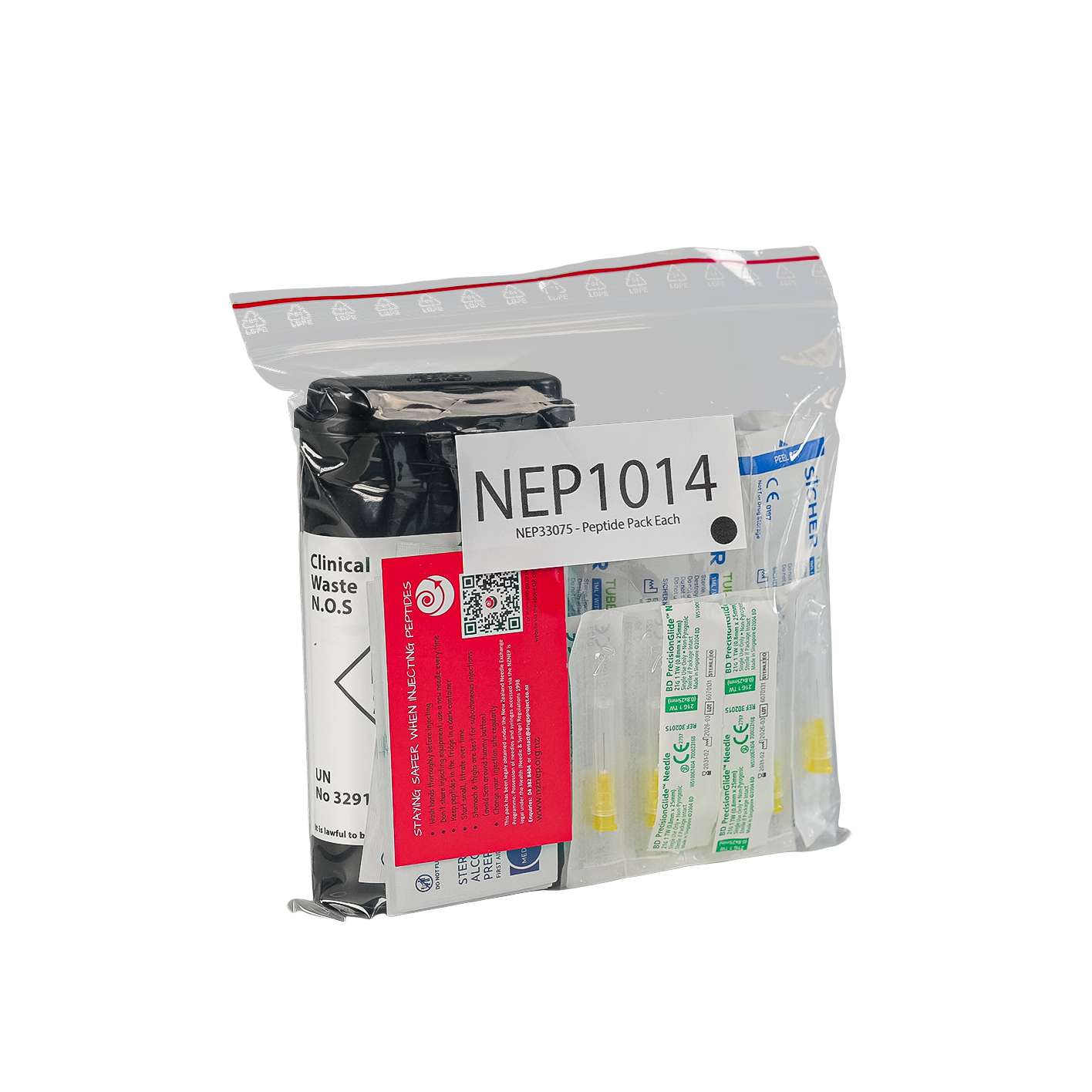
A new peptide-specific injecting pack (NEP 1014) is available through pharmacies in the Needle Exchange Programme. You can find your closest pharmacy here.
The new peptide pack contains:
- 10 x 1ml Luer Slip Sicker Syringes (low dead space)
- 10 x 30g Sharp Needles
- 2 x 21g 1" Draw-up Needles
- 10 x Alcohol Prep Pads
- 1 x 300ml Returns Container
- 1 x Information Leaflet
Can you get your peptides checked at a drug checking service?
Currently, drug checking for peptides is limited in what it can confirm, but it is still worth
getting them checked to confirm if unexpected substances are present.
You can also have a non-judgmental and confidential conversation about harm reduction
tips. We hope that technology and checking techniques will become better at identifying
peptides in the future.
Find more info at www.thelevel.org.nz
Signs you need to seek medical help
Fever, chills, flu-like symptoms.
- Redness, swelling, pus, or worsening pain at injection sites.
- Dizziness, fainting, confusion.
- Chest pain or shortness of breath.
- Yellowing of skin or eyes.
- Persistent nausea or vomiting.